
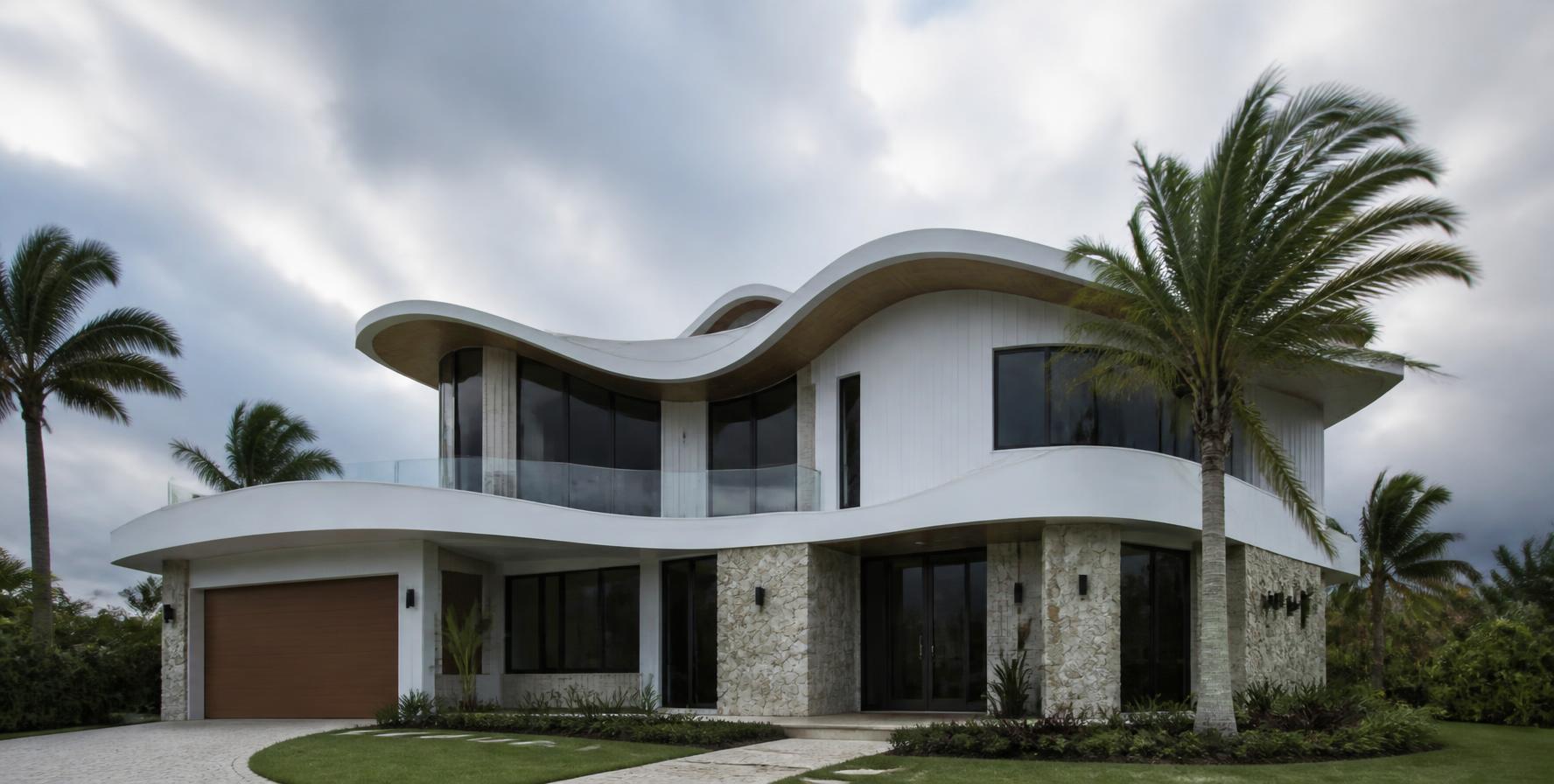
Quick answer: New Florida university research suggests that wave-shaped roofs and exterior walls may reduce some of the most damaging wind pressures on buildings. In wind-tunnel tests, certain models experienced 40% to 60% lower peak pressure near roof and wall corners. Those measurements do not mean homes will sustain 40% to 60% less hurricane damage or receive equivalent insurance discounts.
What did Florida researchers discover?
Engineers at the FAMU-FSU College of Engineering tested small-scale, 3D-printed low-rise buildings with gently undulating roofs and walls. Their deepest wave patterns lowered peak wind pressure near vulnerable corners and edges when compared with conventional flat-surface models. The findings were reported in Engineering Structures and highlighted by Popular Science in October 2026.
The idea is straightforward: a building’s shape changes how wind moves around it. Curved, wave-like surfaces can break up concentrated swirling airflow that creates powerful suction along roof edges. The researchers tested several wave sizes and wind directions; the deepest patterns studied had the largest reductions.
Does that mean wave-shaped houses are hurricane-proof?
No. The research measured pressures on scaled models in controlled wind-tunnel tests. It did not establish how complete, occupied homes would perform during real hurricanes, what construction would cost, or whether insurers would offer a premium credit. Wind resistance also depends on roof connections, openings, materials, installation quality, and the building as a whole.
Why does roof design matter so much in Florida?
Roof edges and corners can experience particularly strong uplift forces during high winds. Damage to the roof covering or structural connections can expose the interior to rain. For Florida homeowners, that makes wind-resistant construction an important part of managing storm exposure, even though no design eliminates hurricane risk.
What can homeowners do today?
- Review roof condition: Address loose roofing materials and documented defects with a qualified contractor.
- Evaluate wind mitigation: Ask about roof-to-wall connections, roof deck attachment, roof shape, and protected openings.
- Check openings: Confirm that shutters, impact-rated products, and garage-door protections are appropriate for the property.
- Review insurance details: Understand the hurricane deductible, policy limits, and any applicable wind-mitigation credits.
- Do not overlook flooding: Wind-focused construction does not replace flood insurance.
A licensed Florida insurance agent can explain which documented wind-mitigation features a particular carrier recognizes. Call or Text (407)781-1600 to discuss your homeowners insurance options.
Will a wave-shaped roof lower homeowners insurance premiums?
Not automatically. Insurance credits depend on a carrier’s approved rating rules and qualifying evidence. This emerging design is not established by this study as an eligible wind-mitigation discount. Before investing in unfamiliar construction features, ask a licensed engineer, local building official, and insurance agent about code compliance, costs, and insurability.
What does this research mean for future Florida construction?
The findings suggest that architecture may help reduce wind loads, alongside stronger building materials and connections. More testing, practical engineering, and code evaluation would be needed before these shapes become common in residential construction. For existing homeowners, proven, properly installed mitigation measures remain the more immediate consideration.
Frequently asked questions
Can curved roofs withstand hurricanes better?
Some curved or wave-shaped models showed lower wind pressures in laboratory tests. Performance on a real home depends on its complete engineered design and construction quality.
Is a 60% wind pressure reduction the same as 60% less damage?
No. Wind pressure is one factor in a building’s exposure. The study did not quantify real-world loss or insurance claim reductions.
Does homeowners insurance cover hurricane wind damage?
Many Florida homeowners policies include windstorm coverage, but exclusions, deductibles, limits, and policy conditions vary. Flood damage is generally treated separately.
Can existing Florida homes benefit from wind mitigation?
Yes, qualifying improvements may strengthen vulnerable components, and some documented features may qualify for credits. Eligibility varies by insurer and policy.
Florida homeowners should focus on proven protection while research advances
Wave-shaped building designs are a promising direction for hurricane engineering, but they are not yet a substitute for sound construction, code-compliant repairs, and appropriate insurance. Sun Insurance Services is a family-owned independent insurance agency serving Orlando and Central Florida since 2003. To review your coverage and potential wind-mitigation documentation, Call or Text (407)781-1600.
Sources: FAMU-FSU College of Engineering research announcement; Florida State University News; Popular Science coverage.